

We get this question in the showroom more than almost any other: “how many tiles is too many?” Honestly, if you’ve got a great eye or you’ve done a few projects before, there’s no real ceiling, some of the best homes we’ve tiled break every rule we’re about to give you. But if you’re not confident trusting your gut on this one, there’s a simple formula that keeps a whole house feeling cohesive without you needing to second-guess every selection.
Pick one main tile and let it do the heavy lifting
Every project needs a workhorse. This is the tile that runs through the spaces that connect — main bathroom floor and walls, hallway, laundry, maybe the ensuite too if it suits. We’re big fans of a large-format neutral here, something with enough presence to read as intentional but calm enough that it doesn’t fight with anything else you introduce later. Rectified edges help too, since tighter grout lines make that continuity read as one surface rather than a patchwork of rooms.
The point of the main tile isn’t to be the star. It’s the thread. Walk from the laundry to the ensuite and your eye shouldn’t snag on a change of tone or format, it should just flow.
Then let each space earn one feature
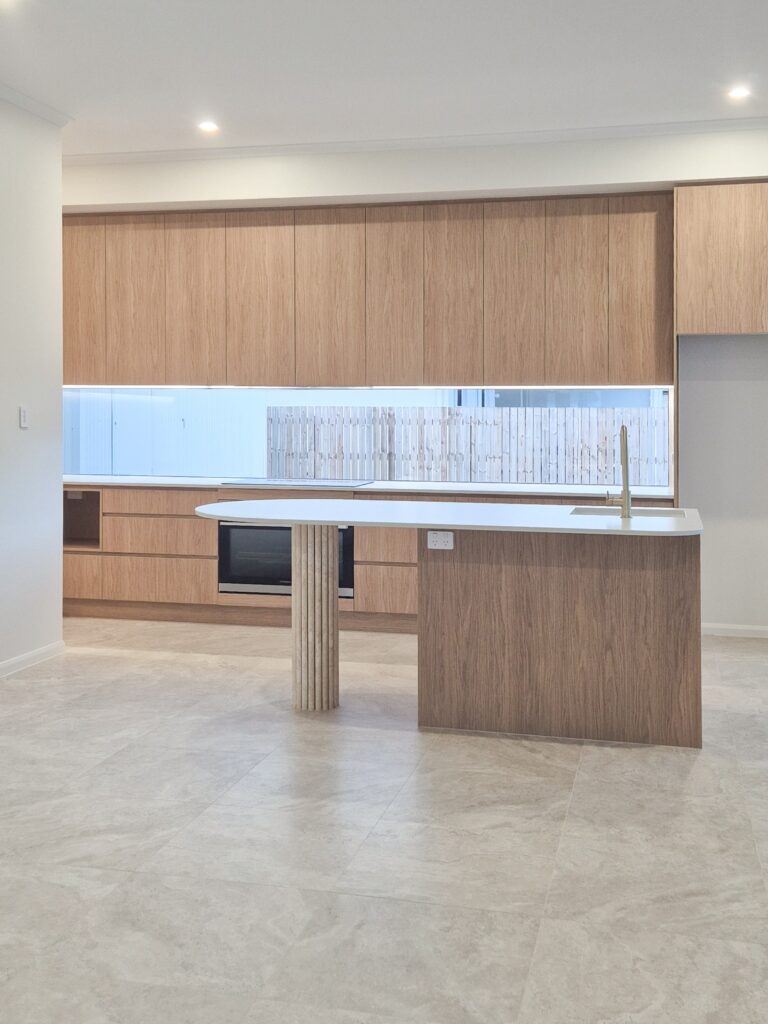
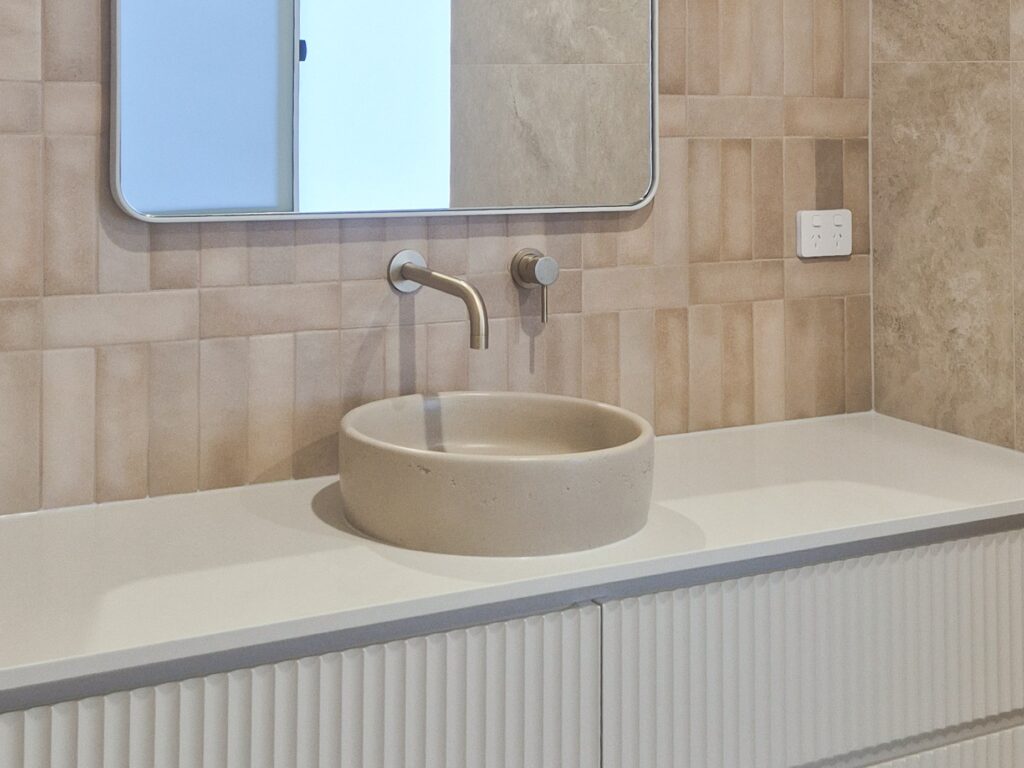
Once the main tile’s locked in, that’s your licence to have fun in the smaller, more contained spots. A kitchen splashback is a classic feature moment, and it doesn’t need to match the floor tile at all, it just needs to feel like it belongs to the same overall palette. A powder room can carry a full feature wall since it’s a small, contained room people only spend a few minutes in. We’re big fans of using a different feature tile in each bathroom so that each has its own personality, but feels cohesive thanks to the main tile.
And if you’ve got a pool, coping is its own decision entirely, different ranges have different coping styles, and even finishes, so if you want your pool to match, ask us what ranges will allow you to coordinate the whole home.
The formula, if you want one
One main tile. One feature per space, chosen at the same time, in the same light, against the same fixed finishes (benchtops, cabinetry, tapware). That’s it. It’s not a rule you need forever, it’s just an easy rule to follow for a cohesive home.
If you’re mid-plan and want a second set of eyes on where your tile budget should go, bring your floor plan into the showroom and we’ll go through it room by room with you.