

Most people choose a feature tile by colour and finish. They fall for a gorgeous green, a soft marble-look, a warm terracotta – and then they’re surprised when it doesn’t quite land the way it did in the showroom or on Pinterest.
Nine times out of ten, the culprit isn’t the tile. It’s the scale.
The size and shape of a tile changes how a whole wall feels, often more than the colour does. Get the scale right and even a simple white tile becomes a feature. Get it wrong and a beautiful tile can feel busy, fussy or weirdly flat.
So before you lock anything in, it’s worth understanding how scale actually works.
Same Wall, Two Completely Different Looks
Here’s the clearest way to see it. This is the same little vanity wall both times — same mirror, same basin, same dimensions. The only thing that changes is the tile.
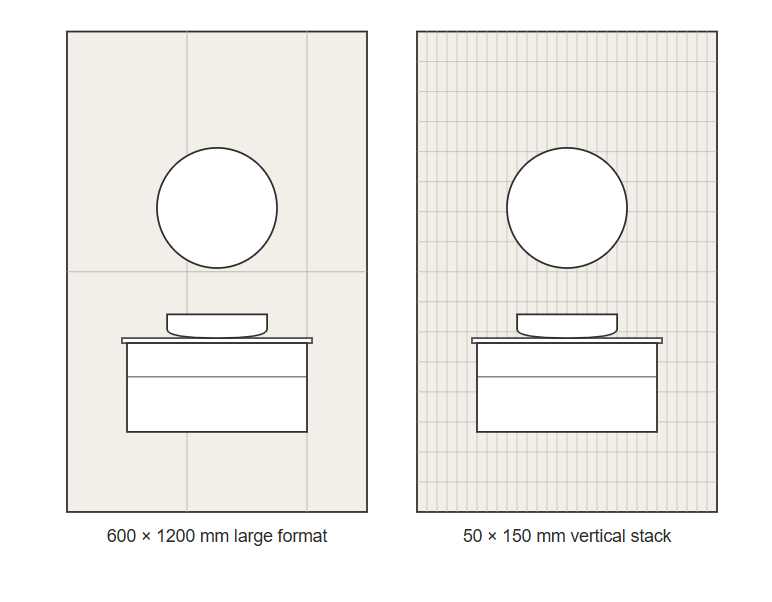
On the left, a 600x1200mm large-format tile. With barely any grout lines, the wall reads as one smooth, continuous surface. It feels calm, contemporary and a touch luxe — and on a small wall, fewer lines make the space feel bigger and more open. BUT, if you choose a dramatic pattern you may have some awkwards cut on a shorter wall like this.
On the right, a 50x150mm subway laid in a vertical stack. Suddenly the wall has rhythm and texture. All those fine vertical lines draw your eye upward, which makes a low ceiling feel taller and gives the room real personality.
Neither is better. They’re two different moods, achieved with nothing but tile size and orientation.
Considering scale on your splashback
A kitchen or laundry splashback is one of the best places to be a little bolder, because the area is small and contained. The scale conversation matters just as much here.
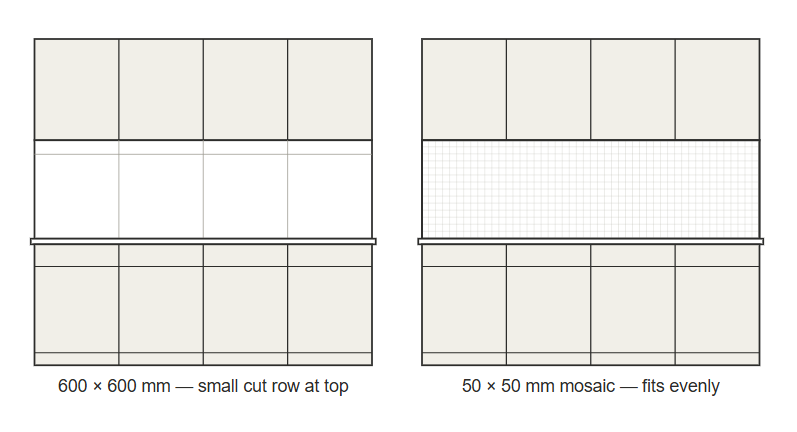
A large-format slab-look splashback (often a single sheet, or very few joins) gives you that seamless, premium feel behind the cooktop, and it’s easy to keep clean. Keep in mind your splashback is likely to be 650mm or higher, anything up to 900mm in a laundry, so you don’t want an awkward cut when using a large tile.
Go the other way with a stacked subway, a gloss finger tile or a handmade-look mosaic, and the splashback becomes the personality of the whole room.
The trick is balance. If your benchtop is busy with movement and pattern, a calmer large-format splashback lets it shine. If your cabinetry and bench are quiet and simple, that’s your invitation to make the splashback the feature.
A quick way to get it right
Think about what the room needs before you think about the tile. Small space that needs to feel bigger? Lean larger, with fewer grout lines. Big blank wall that feels cold? A smaller format adds warmth and texture. Low ceiling? A vertical layout lifts it. Want one hero moment in an otherwise simple room? That’s your feature wall, and smaller or patterned tiles will earn their keep there.
And please, always look at a tile at the size you’ll actually use it. Scale only really shows itself across a whole surface, which is exactly what we’re here to help you picture.
Come and see it for yourself
Bring your bench sample, a photo of the space, even just a vague idea — Brian and the team love helping people work out the right scale for their room. We’ll pull tiles, lay them out, and show you the difference in person.